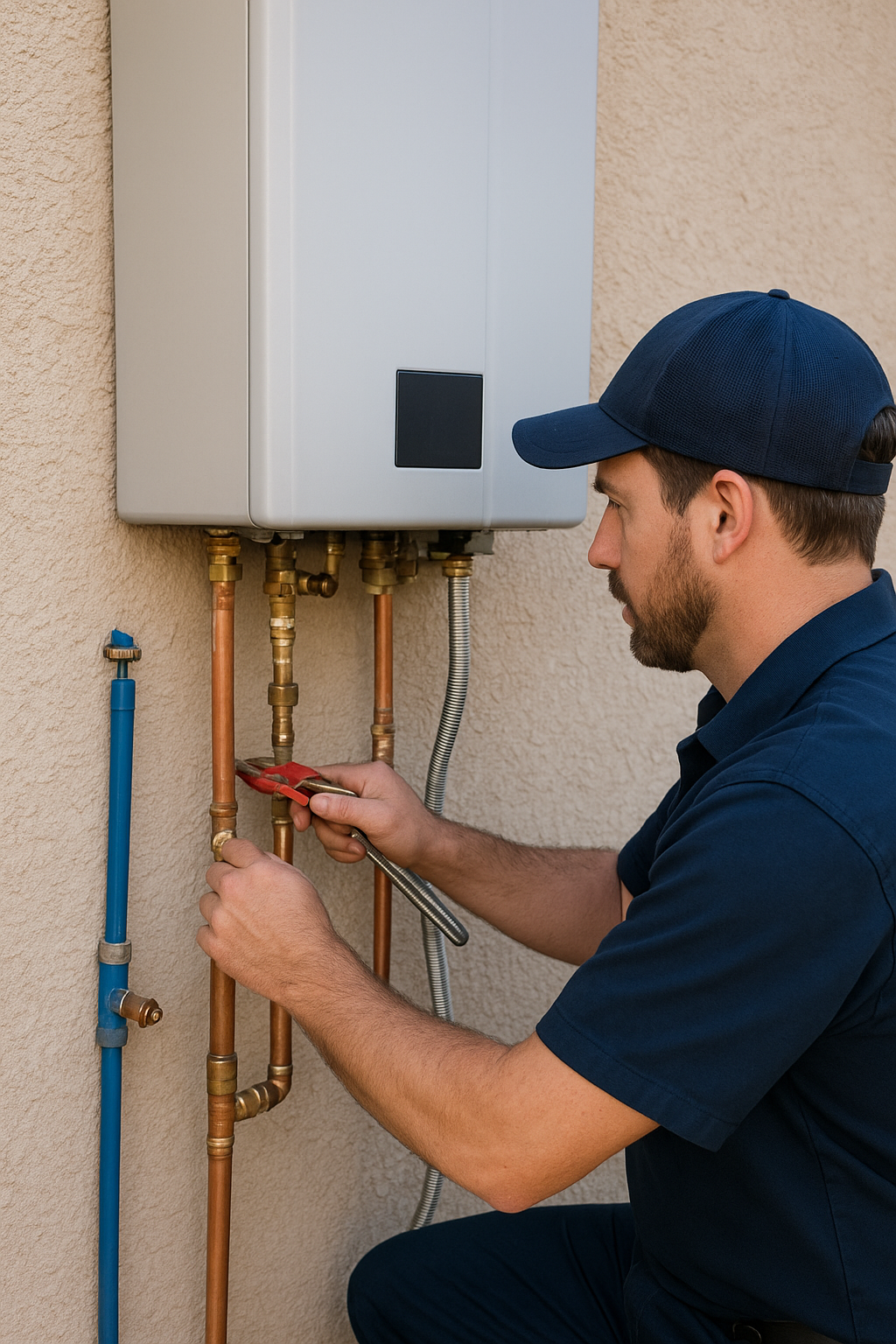
Phoenix homes in Arcadia and Biltmore often date from the 1950s through 1980s, with smaller gas lines and limited venting that complicate tankless retrofits. Extreme summer temperatures push incoming water into the 90s, increasing scale formation on heat exchangers when homeowners skip annual descaling. Maricopa County water carries high mineral content that coats sensors and burners faster than in newer builds, leading to error codes during peak demand. Proper sizing must account for simultaneous fixtures in larger Camelback East properties rather than relying on manufacturer charts alone.
Installation in Ahwatukee or South Mountain frequently requires upsizing gas lines from half-inch to three-quarter-inch to maintain pressure when multiple units run. Existing vent paths through stucco walls need stainless steel terminations rated for high exhaust temperatures, and roof penetrations must clear tile edges without compromising waterproofing. Electric models demand dedicated 240-volt circuits sized for the amperage draw, which older Maryvale panels rarely support without upgrades. Technicians check for seismic strapping requirements even on interior units because of local soil movement.
Routine maintenance includes isolating the unit, circulating vinegar solution for 45 minutes, and inspecting the inlet screen for sediment common after monsoon dust events. Replacement parts such as flow sensors and igniters must match the exact model because aftermarket versions fail quickly under Phoenix's continuous high-temperature operation. Homeowners who notice fluctuating temperatures during the first hot spell of the year should schedule service before the unit locks out entirely.
Technician insight
In Phoenix the thing that catches most people out with tankless water heaters is the speed of scale buildup on the heat exchanger when summer inlet water sits in the 90s and annual vinegar flushes get skipped. Homes in Arcadia and Biltmore with original half-inch gas lines also lose pressure the moment two showers run, something that never shows up on a quick inspection.
Fluctuating Temperature In Arcadia Home
Homeowner reported temperature swings during morning showers in an Arcadia property built in the 1970s. Inspection revealed heavy scale on the heat exchanger and a partially clogged inlet screen from monsoon sediment. We isolated the unit, performed a full vinegar circulation, replaced the flow sensor, and restored stable output across all fixtures.
Tankless Water Heater Services We Offer
✓Tankless Water Heater Installation
Full replacement of traditional tanks with gas or electric tankless units sized for Phoenix household demand, including gas line and venting upgrades.
✓Tankless Water Heater Repair
Diagnosis and replacement of failing components such as heat exchangers, flow sensors, and circuit boards damaged by hard water scale.
✓Annual Descaling Service
Vinegar flush and inspection to remove mineral buildup that restricts flow in units serving homes near Papago Park and the Phoenix Zoo.
✓Gas Line Sizing and Upgrade
Evaluation and replacement of undersized lines to support tankless demand without pressure drops during summer peak usage.
✓Electric Tankless Conversion
Panel assessment and dedicated circuit installation for homeowners switching from gas in neighborhoods with limited gas availability.
Tankless Water Heater Cost in Phoenix, AZ
| Service | Typical Range | What Affects It |
|---|---|---|
| Annual Descaling | $150–$250 | Higher in homes with known hard water or skipped prior service |
| Sensor Or Igniter Replacement | $300–$550 | Parts plus diagnostic time; model-specific components |
| Full Gas Tankless Installation | $1,800–$3,200 | Includes basic venting; rises with gas line upsizing |
| Electric Conversion | $2,100–$3,800 | Depends on panel capacity and circuit run length |
Ranges are typical for Phoenix, AZ and confirmed with an exact written quote before any work starts.
How it works
- 1
Site Assessment
Technician measures existing gas or electric service, checks venting routes, and tests water pressure at the meter in the specific Phoenix neighborhood.
- 2
Unit Selection And Sizing
Calculate simultaneous fixture load and select model rated for 90-plus degree inlet water common during Phoenix summers.
- 3
Installation And Connections
Mount unit, run new gas or electric lines, install venting, and connect to existing plumbing with proper isolation valves.
- 4
Testing And Commissioning
Run multiple fixtures, verify temperature stability, and program any recirculation settings before final walkthrough.
Pricing
Most tankless projects in Phoenix fall between modest repair calls and full retrofits that require gas line work.