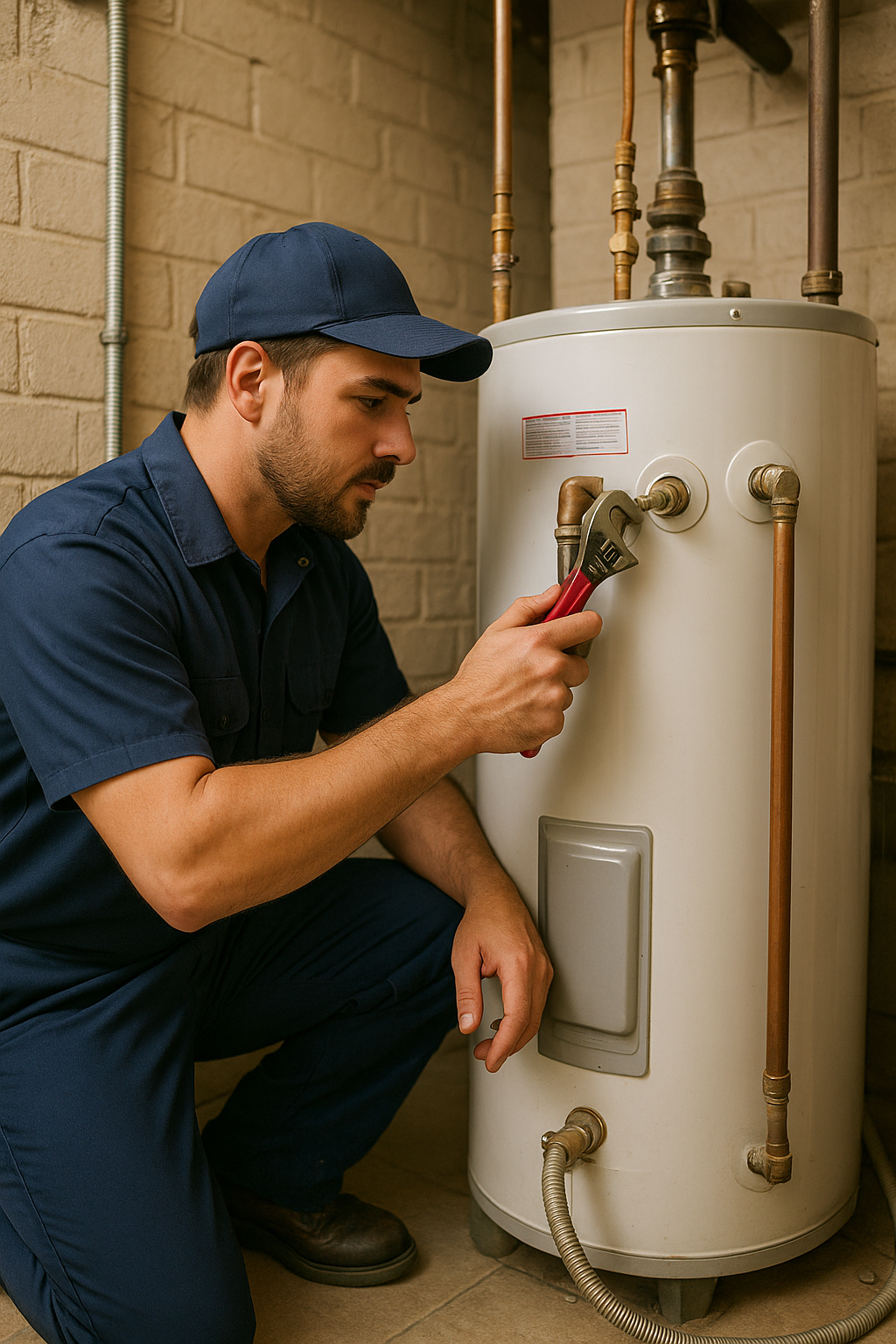
Phoenix water heaters face constant stress from 110-plus degree summers that accelerate mineral scaling inside tanks. In neighborhoods like Arcadia and Biltmore, many homes built in the 1970s and 1980s still run original units or early replacements that now show frequent element and anode failures. Technicians routinely open tanks to find thick sediment layers that reduce capacity and overheat lower elements, especially on electric models common in Maryvale and South Mountain.
One quick clarification that saves Phoenix homeowners confusion: homes here don't use boilers. In colder regions a 'boiler' heats water for radiators, but Phoenix homes run standard tank or tankless water heaters for hot water and furnaces or heat pumps for heating. So if your hot water has failed and you searched for boiler repair, what you actually have is a water heater — and that's exactly what we diagnose, repair, and replace, whether it's gas or electric. If you're considering switching to on-demand hot water, our tankless water heater service covers repair and installation.
Gas units in Camelback East often develop valve and thermocouple problems when dust from nearby desert terrain mixes with the high summer load. Homeowners sometimes notice fluctuating temperatures or pilot outages after monsoon dust storms. Repair work here frequently includes checking the temperature and pressure relief valve for proper function, because extreme heat cycles can weaken the spring over time and create safety risks if left unaddressed. If you notice unexplained water pooling near the unit rather than a clear tank leak, our leak detection service can pinpoint whether the source is the heater or a nearby supply line.
The hardest decision most homeowners face isn't what's wrong — it's whether to keep repairing or replace. A storage tank lasts about 10 to 15 years, so a unit under 8 years old with one failed part is almost always worth repairing. But once you're past 10 to 12 years, or the tank shows rusty water and its second or third failure, another repair is just kicking the can down the road. Phoenix's hard water and heat tend to shorten that window, so we give you the numbers for both paths and let you decide with the full picture — a burned-out element on a young tank is a quick fix, while the same symptom on an aging, rust-streaked unit is a sign to replace before it leaks.
Repair decisions also depend on the home's water source. Areas closer to Papago Park and the Phoenix Zoo often see harder water that speeds up corrosion on dip tubes and heat exchangers. When that same hard water has also corroded a home's original supply lines, a whole-house repipe is sometimes the better long-term fix than repeatedly working around failing pipe. A technician will inspect the existing venting on gas models and the electrical connections on electric models before quoting, since code in Maricopa County requires specific clearances that older installations sometimes violate.
Technician insight
In Phoenix the thing that catches most people out with water heater repair is how fast sediment builds in the bottom of the tank once summer temperatures stay above 105 for weeks. Homes in Arcadia and Ahwatukee with original 1980s tanks often lose capacity without any leak, and the lower element burns out repeatedly until the tank is flushed. Skipping the flush just moves the failure to the next part.
South Mountain Electric Water Heater Failure
Homeowner in South Mountain reported no hot water after a week of 110-degree days. Inspection showed both elements failed and several inches of sediment on the tank bottom. We replaced the elements, flushed the tank, and tested the T&P valve. Unit regained full capacity and stable temperature without further issues.
Water Heater Repair Services We Offer
✓Electric Element Repairs
Replace burned-out upper or lower heating elements and test thermostats on electric water heaters common in Phoenix homes.
✓Gas Control Valve Repairs
Diagnose and replace faulty gas valves and thermocouples that cause pilot light failures during Phoenix summer heat loads.
✓Anode Rod Inspection and Replacement
Pull and inspect the anode rod, then install a new one to slow tank corrosion accelerated by Phoenix hard water.
✓Sediment Flushing Service
Power flush accumulated mineral buildup from tanks to restore capacity and prevent overheating in desert conditions.
✓Emergency & Same-Day Repair
Priority response for no-hot-water and leaking-tank calls across Phoenix, with same-day slots when a unit fails in peak summer heat.
✓Temperature Pressure Relief Valve Testing
Test and replace T&P valves that can weaken from repeated expansion cycles in Phoenix's extreme temperature swings.
Water Heater Repair Cost in Phoenix, AZ
| Service | Typical Range | What Affects It |
|---|---|---|
| Electric element replacement | $180–$350 | Higher when both elements and thermostats need replacement or access is tight. |
| Gas valve repair | $225–$425 | Price rises with thermocouple and venting corrections. |
| Anode rod replacement | $150–$275 | Includes flush; older tanks in hard-water areas take longer. |
| Full sediment flush | $125–$225 | Required when capacity loss is severe in desert homes. |
Ranges are typical for Phoenix, AZ and confirmed with an exact written quote before any work starts.
How it works
- 1
Initial Assessment
Arrive at the Phoenix property and confirm the water heater model, fuel type, and visible symptoms before shutting off power or gas.
- 2
Component Testing
Check elements, valves, thermostats, and anode condition using multimeter and visual inspection to isolate the failure.
- 3
Repair Execution
Replace the failed part, flush sediment if needed, and verify venting or electrical connections meet local requirements.
- 4
System Verification
Restore service, run the unit through a full cycle, and confirm temperature stability and leak-free operation.
Pricing
Most water heater repairs in Phoenix fall into common ranges based on parts and access; exact cost depends on model age and sediment level.